|
GREEN INTEGER750 S. Spaulding Ave., Suite 112
Los Angeles, CA 90036 |
Essays, Manifestos, Statements, Speeches, Maxims, Epistles,
Diaristic Jottings, Narratives, Natural histories, Poems, Plays, Performances,
Ramblings, Revelations, and all such ephemera as may appear necessary to bring
society into a slight tremolo of confusion and fright at least. |
|
|
|
Listen to the Mockingbird: American Folksongs and Popular Music Lyrics of the 19th Century — Anthology — Edited with an Introduction by Douglas Messerli
|
|
Price: U.S. $12.95
Series No.: 130
ISBN: 978-1-892295-20-0, Pages: 204
American Literature, Music
|
 |
Editor Douglas Messerli has collected 78 lyrics of American folksongs and popular music. The African American spirituals, the chanteys, and the cowboy songs are beautiful paeans to the American way of life. But the rest are often perverse in their racial humor and sexual undertones, especially the minstrel songs and the Civil War ballads. These lyrics both energize and frighten us, not unlike the wild and open American landscape. From the patriotically conceived “America” (1832), to the rebelliously insistent “I’ll Marry the Man I Love” (1897), Listen to the Mockingbird reveals our national identity.
*
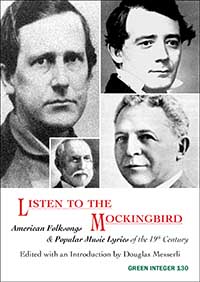
Cover photographs (clockwise from left):
Stephen Collins Foster
Septimus Winner
Charles K. Harris
George F. Root
*
CONTENTS
All God’s Chillun Got Wings
Bought Me a Cat
Carry Me Back to Green Pastures
Coming ’Round the Mountain
The Drunken Sailor (What Shall We Do with a Drunken Sailor?)
Ezekiel’s Wheel
Go Down, Moses
I’ve Been Working on the Railroad
Joshua Fit de Battle ob Jericho
Nobody Knows the Trouble I’ve Seen
The Old Chisholm Trail
Polly Wolly Doodle
Red River Valley
Roll Jordan, Roll
Shenandoah
Short’nin’ Bread
Swing Low, Sweet Chariot
America (1832)
Zip Coon (Turkey in the Straw) (1834)
Rocked in the Cradle of the Deep (1840)
We Won’t Go Home Till Morning (1842)
Buffalo Gals (1844)
Jim Crack Corn (1846)
Simple Gifts (1848)
Susanna (Oh! Susanna) (1848)
De Camptown Races (1850)
Old Folks at Home (Swanee River) (1851)
Wait for the Wagon (1851)
My Old Kentucky Home, Good Night (1853)
Hard Times Come Again No More (1854)
Listen to the Mockingbird (1855)
Some Folks (1855)
Jingle Bells, or The One Horse Open Sleigh (1857)
The Yellow Rose of Texas (1858)
Dixie (1859)
Old Black Joe (1860)
Aura Lee (1861)
The Battle-Cry of Freedom (1861)
Battle Hymn of the Republic (1862)
Grafted into the Army (1862)
Beautiful Dreamer (1862)
Just Before the Battle, Mother (1862)
Kingdom Coming (Year of Jubilo) (1862)
Tenting Tonight on the Old Camp Ground (1863)
All Quiet Along the Potomac (1863)
The Arkansas Traveler (1863)
Kissing in the Dark (1863)
My Wife Is a Most Knowing Woman (1863)
There Are Plenty of Fish in the Sea (1863)
When Johnny Comes Marching Home (1863)
Der Deitcher’s Dog (1864)
Shall We Gather at the River? (Beautiful River) (1864)
Tramp! Tramp! Tramp! (1864)
Jeff in Petticoats (1865)
Marching Through Georgia (1865)
Goober Peas (1866)
The Little Brown Jug (1869)
Shew Fly Don’t Bother Me (1869)
Sweet Genevieve (1869)
Reuben and Rachel (1871)
Silver Threads Among the Gold (1873)
Bringing in the Sheaves (1874)
Grandfather’s Clock (1876)
Carry Me Back to Old Virginny (1878)
Oh, Dem Golden Slippers! (1879)
In the Evening by the Moonlight (1880)
Ring Dem Heavenly Bells (1883)
My Thoughts Are of Thee (1884)
Clementine (1885)
Johnny Get Your Gun (1886)
There Is a Tavern in the Town (1891)
After the Ball (1892)
Daisy Bell (A Bicycle Built for Two) (1892)
The Sidewalks of New York (1894)
The Band Played On (1895)
A Hot Time in the Old Town (1896)
Sweet Rosie O’Grady (1896)
I’ll Marry the Man I Love (1897)
|
Book Review(s)
UTNE READER,
January-February 2006
by Sarah Wash It’s odd to find "Red River Valley" and "Oh Susannah" in a volume bound for libraries, bookstores, and literary analysis. Nevertheless, archiving American cultural history is important in its own right, and this book offers some unusual glimpses into our country’s playful—and often sordid—collective imagination. From the infrequently sung mocking verses of "Jingle Bells" to the hilarious "Jeff in Petticoats" (Confederate president Jefferson Davis escaped soldiers in his wife's coat) to the disturbing "minstrel tunes" sung by whites in blackface, these folk tunes, many of which are now treated as children's songs, are anything but innocent. Tales of abuse, alcoholism, prisoners, war, starvation and incest provide some context to reality TV and America's enduring profane/sacred split personality.
BOOKFORUM, XIII,
no. 3 (September-November 2006)
by Stacey Levine The
introduction to Listen to the Mockingbird
suggests that American popular music of one hundred years ago was not sunny,
charming, or naïve, as is sometimes assumed. While some songs in this
pocket-size volume are benign or comic, such as "Bought Me a Cat," which is
related to "Old MacDonald's Farm," most describe war, poverty, familial
relations, death, and slavery. The blowsy characters and coarse motives running
through these old tunes form a link to the careening American cultural present
and to our fascination with bad luck and sordid domestic situations.
Though "Clementine" may no longer be
familiar to anyone under thirty-five, its more obscure verses are likely
unknown even to those who can recall its memorable chorus. The song is a
subterranean-sounding tale of a miner who returns from work to "caress" his
daughter Clementine, who is his "favorite nugget." He eventually mourns her
after she falls to her death in the "raging brine." A later variation of the
verses sees the miner forgetting Clementine after kissing his younger daughter.
A curious, similarly themed number from 1892, "After the Ball," describes a man
broken-hearted after discovering his beloved kissing another; years later,
never having married, he finds out that the man was his fiancée's brother. Even
the holiday favorite "Jingle Bells" rings with bizarre malice. Written by James
Pierpont, a New Englander who relocated to the South, the original version contains
two rarely heard verses that imbue the song and its famous chorus with sarcasm.
In one, a man lies on his back in the snow beside his tipped-over sleigh, while
another man glides past, laughing at the accident.
Many popular songs from the nineteenth
century were written for performance groups such as the Christy Minstrels, a
blackface troupe formed in Buffalo, NY, in 1843. Editor Douglas Messerli
includes the original lyrics, in transliterated slave dialect, from "Jim Crack
Corn," "Dixie," "Ring Dem Heavenly Bells," and others, observing in his
introduction and footnotes that, given the era's pervasive racism, even those
with antislavery tendencies were susceptible: Liberal, abolitionist composer
Stephen Foster (as famous in his day as Andrew Lloyd Webber is in ours) wrote
lyrics containing stereotypes and white haughtiness.
The other piece of misery reflected in
these song lyrics is the Civil War. Some army songs from the era reflect
soldiers' misery and uncertainty. Composer George F. Root's "Tramp! Tramp"
Tramp!" refers to dying Union men in the Confederate prison camp in
Andersonville, GA, and in Root's "Just Before the Battle, Mother," a soldier
notes earnestly that, for "The Battle-Cry of Freedom," he might "nobly perish."
Messerli offsets such solemnity with the inclusion of "Jeff in Petticoats," a
romping, broadly mocking number that recounts Confederate president Jefferson
Davis's rumored attempt to flee Richmond (and pursuing Union soldiers) in his
wife's clothing.
Although the world of riverbanks,
blackface, Indian chiefs' daughters, and North-South split is blurrily distant
across time, this collection of historical lyrics should remind readers that
our current cacophony and chaos, along with our unmanageably disruptive
cultural struggles, have always been with us.
|
|
|
|
|


